How to Create a Cartoon Starring Your Child
Imagine a cartoon hero wearing your child’s favorite boots, befriending a bird they invented and exploring a story you wrote together. For a first episode, start with one wish, a small obstacle and three clear scenes.
Start with your child’s interests
Choose something that already sparks curiosity: dinosaurs, space, drawing, animals or magical objects. Ask your child where the hero will go and whom they will help. Two simple questions — “What will you find there?” and “What will you do next?” — can become the beginning of a plot.
Personal stories feel familiar when they include favorite things and habits. Use a yellow raincoat, a toy companion or a phrase your child often says. Choose two or three details and carry them into the story.
1. Turn your child into a cartoon hero
Describe the hairstyle, main clothing colors, favorite accessory and personality. A cartoon design can use recognizable features and a clear silhouette. A photo is optional: a description or drawing can also provide a starting point.
Show your child the first design and let them choose details. Which boots do they like? Should the hero carry a backpack? Who will be the companion? Save the accepted design as a reference so the face, clothes and proportions remain recognizable in later scenes.
A sample main-character sheet
Replace the name, clothes and interests with details that suit your child. The adventure can be entirely fictional. A few personal touches are enough for recognition; a surname, school or other real-life information is usually unnecessary for the plot.
2. Give the hero a goal and a meaningful action
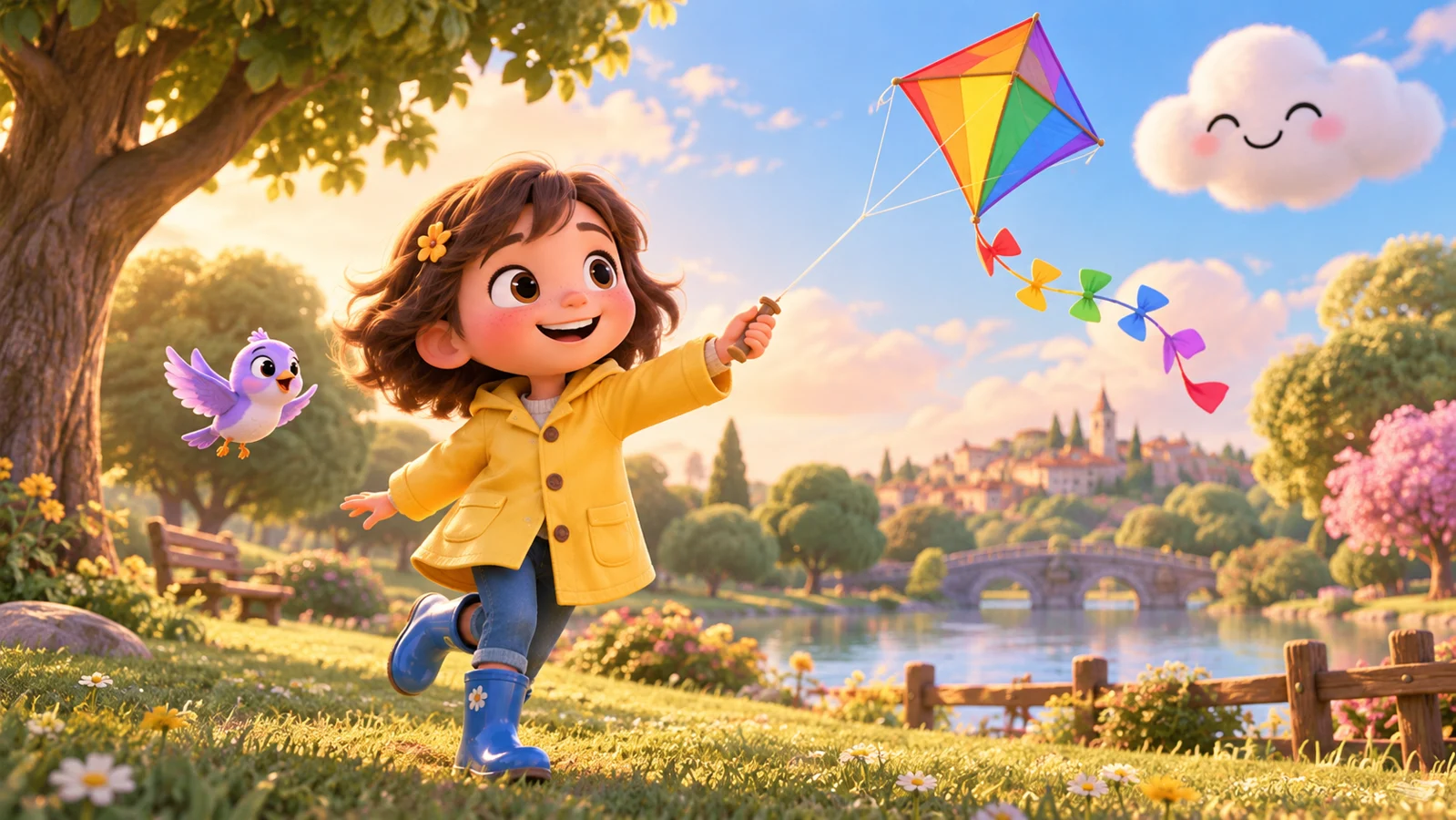
Let the child’s character make a decision, try an action and see its result. Mira notices a sad cloud and wants to cheer it up. She makes a colorful kite, flies it and brings a smile to the cloud.
Choose a small challenge for the first episode. One kind action or discovery can produce a complete story without a long explanation. A companion may offer support, while the child’s hero makes the key decision and performs the main action.
3. Divide the adventure into three scenes
Give each scene one main action. Add a preparation shot if you want to show the kite being made. Describe things viewers can actually see: a glance, gesture, object or change of expression.
- Setup: Mira and Pip walk through a magical park. A small cloud with a sad face hangs above them. Mira notices it and stops.
- Attempt: Mira shows Pip her rainbow paper kite and lifts it by the string. The bird looks up with curiosity.
- Outcome: the kite gently flies beside the cloud. The cloud smiles, Mira waves and Pip celebrates nearby.
A short script brief
Adapt this starting point to your own story. Replace the park with a moonlit meadow, the bird with a favorite imaginary animal or the kite with another object. Check that the hero’s goal and the reason for the happy ending remain clear.
4. Prepare lines and choose a voice
A few words can be enough for each scene. Mira might ask, “Cloud, why are you sad?” Then say, “Look what I made!” At the end: “Now we have a friend in the sky.” Read the lines together and invite your child to replace them with their own words.
Choose a voice that fits the cartoon character and listen to a sample line. Keep the same voice in later scenes. If your child prefers storytelling, introduce a narrator and reduce the dialogue. Refine the shot timing after voiceover, leaving room for a gesture and reaction.
5. Assemble the scenes and review the draft together
In Pipa, begin with a project and short idea, prepare the script, create the hero’s profile and review the storyboard. Then work on voices, scene movement and editing. Compare each new version with the character design you selected.
Watch the draft with your child. Do they recognize their hero? Is it clear what the hero invented and why the cloud smiled? Choose one moment to improve: a line, gesture or object color. This discussion helps you reach a version you both enjoy.
A family cartoon checklist
- Your child helped choose the adventure and character details.
- The main character makes a decision and performs an important action.
- Appearance, clothing and the companion stay consistent.
- Lines are short, clear and assigned to the correct speakers.
- Each scene has a clear action and room for a reaction.
- The ending follows from the hero’s actions.
- You watched the complete draft together before final assembly.
Ideas for another episode
Save the child-hero profile and invent another adventure with the same companion. Mira could find a letter from the cloud, help Pip build a paper house or organize a kite parade. Recurring characters can connect individual stories into a small family series.
Make an episode for a birthday, a family evening or the pleasure of creating together. Begin with a small story, let your child choose a favorite moment and keep the result as something you imagined together.