From idea to cartoon: how to start your first story
A big cartoon starts with a small question: what does your character want? Let’s go from a first thought to a clear, short story.
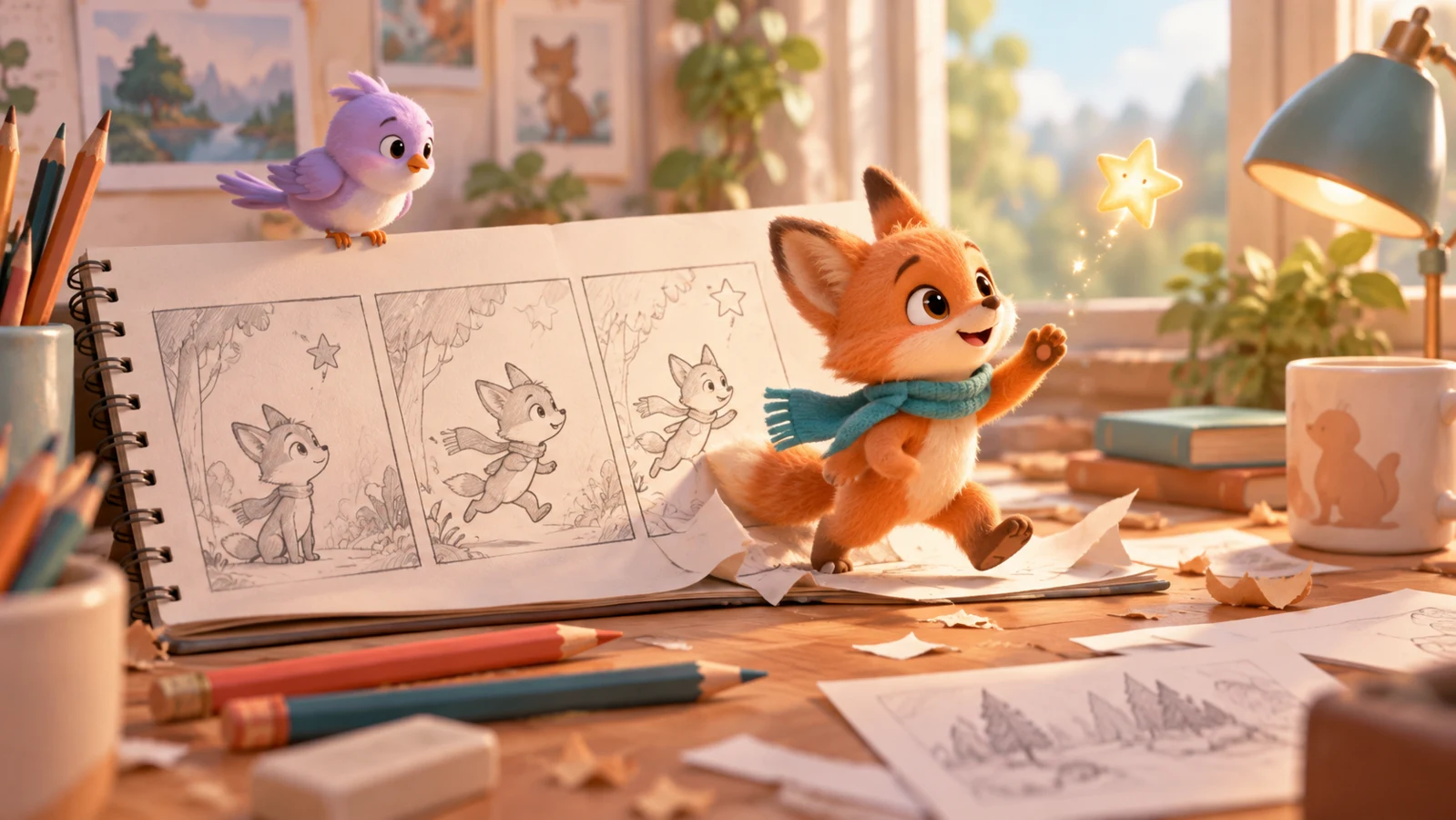
When you want to make your first cartoon, it is tempting to start with a beautiful world: a castle, a forest, a dozen characters and a whole series of adventures. For your first short film, it helps to choose just one moment. Instead of “life in a magical forest,” try “a little fox tries to return a lost star to the sky.” That idea already promises action.
1. Describe your idea in one sentence
Try this simple starting point: “A character wants to do something, but meets an obstacle.” It helps you separate a story from a description of the setting. If the sentence gets too long, remove the side adventures. You can save them for your next cartoon.
2. Give your character a clear goal
It is easier to follow a character when their goal is visible through action. The fox looks at the sky, gently picks up the star and tries to jump. We do not need a long explanation of how kind the fox is: the action already shows us.
Choose one trait that affects the character’s decisions. Perhaps the fox is impatient and tries to solve everything alone at first. An ending where the fox asks a friend for help will then connect to the beginning.
3. Find the beginning, the attempt and the result
Three main events are enough for a first story. At the beginning, the fox finds the star. Then the fox tries to return it and fails. At the end, the fox calls a bird, and the friends find a solution together. You can add details between these moments, but each one should move the story forward.
Check the ending: has anything changed? The star is back in the sky, and the fox has learned that it is okay to ask for help. Even a small result like this makes a story feel complete.
4. Draw three key frames
A storyboard does not need beautiful drawings. A circle for a head, an arrow for movement and a few lines for a tree will do. What matters is knowing what the viewer will see: where the character stands, what they look at and what they do.
Write a short phrase under each frame: “finds the star,” “cannot reach,” “the bird helps.” If the action is hard to explain, try simplifying the scene before moving on to images and animation.
5. Leave room for pauses
Do not fill the whole film with dialogue. A character can look surprised, glance around or smile without speaking. After an important action, give the viewer a moment to notice the result. Read the dialogue aloud and estimate the scene length: the words should fit without rushing.
6. Build a rough cut first
Before making detailed animation, combine your key frames and dialogue into a simple rough cut. Watch it from beginning to end. Is the character’s goal clear? Can you see the obstacle? Is there enough time to understand the ending? Changing the scene order is much easier now than after animating the movement.
7. Finish one small story
Your first cartoon can be very short. Its purpose is to take you through the whole process: idea, screenplay, frames, voices and a review of the result. Write down what worked and what you would like to improve. Those notes will be the starting point for your next film.
Before you begin
- I can describe the story in one sentence.
- The character’s goal and obstacle are clear.
- The story has a beginning, an attempt and an ending.
- I can picture three key frames.
- The scenes leave room for action and pauses.
Now take your idea and shape it into one clear adventure. A small story, finished from start to end, is a great beginning for your own studio.
Your story starts here
Write down your idea and prepare your first screenplay in Pipa Cartoons.
Create a cartoon